From Today, Is Software Dead?
Jul 4, 2026

In 1839, when Daguerre demonstrated the daguerreotype for the first time, the painter Paul Delaroche was in the audience. His verdict became one of the most quoted lines in the history of art: “From today, painting is dead.”
What followed was Impressionism, Post-Impressionism, Cubism, Expressionism, Abstraction. The camera forced painting to answer something it had never needed to ask: what is a painting worth, when faithful reproduction is no longer the measure? When you stand in front of a Monet today, you are looking at the answer. One that only became possible once the old function was gone.
I spent the last six months, and about 80 pages, on the software equivalent of that question. This is what fifteen conversations with founders and investors across Europe left me with.
For two decades, software’s value rested on a scarcity: the difficulty of building it well. The SaaS economy was structured entirely around that constraint, and within it, remarkable things were built.
AI dissolves this scarcity. What once required years of capital and engineering depth, any motivated team can now ship using the same models, the same infrastructure, the same tooling everyone else has access to. The rare resource has become the abundant one. Which makes the interesting question not only what this erodes, but what it makes possible.
Software is having its own Delaroche moment.
Where does value go when the act of creation stops being the constraint?
Frontier Pace x Domain Depth
Technical execution at frontier pace serves as the entry requirement. Each model release pushes the floor up, and the teams that fall behind it rarely catch up. Staying competitive means building an organisation architected for this pace: AI fluency across every function, converging roles, the judgment to redirect without losing coherence. The companies that will survive are the ones that hold themselves to the same standard they are selling.
But the capability that actually differentiates is translation. Staying close to the frontier only matters if you know which capabilities to translate into the product, how to fit them to the actual workflows of a specific industry, what to leave alone. This is knowledge that comes from structural domain depth: from years inside an industry, from understanding the constraints and failure modes that never make it into a specification. The best products today are built with customers, through proximity, because there is no other way to hold both speed and depth at once.
No Trust, No Distribution
Distribution has become the primary constraint as technical differentiation erodes. When products converge at the same technical floor, access to the right customers determines who gets to deploy, and therefore create durable value, at all.
That access is built through trust, accumulated long before the first sales conversation: through domain credibility, compliance certifications, alignment with EU sovereignty positioning, presence in the communities where decisions happen before RFPs are written. This is why narrative and visibility have become structural advantages. The founders who write, who speak, who build in public are compressing what used to take years of relationship-building into something that scales. Storytelling is distribution. Distribution is part of the product.
The Role of Forward-Deployed-[Industry Title of Choice]
Most AI pilots never make it to production. The technology works. The people don’t follow. Customer teams resist workflow changes designed without them. Budget cycles end before organisational change catches up. This is where most enterprise AI value disappears, in the distance between what the product can do and what the organisation is willing to become.
The ventures closing this gap are doing something closer to consulting than software: staying inside a customer’s operations through the change, helping build the internal case, earning the trust of the people whose work is being restructured. OpenAI announced last week that it is investing $150 million in a partner network and aims to train 300,000 consultants by the end of 2026. The reason, stated plainly: “the limiting factor for seeing value from AI in the enterprise is no longer model capabilities. Instead, it’s how organisations repeatably identify the right use cases, redesign workflows, integrate with existing systems, and drive adoption.“ Even the company building the frontier model is saying the frontier model is not the constraint. The deployment work is.
What accumulates through this process cannot be recovered by a competitor who rebuilds the product. The workflow logic embedded inside a customer’s operations. The proprietary interaction data generated through actual use. The understanding of where processes break, which decisions carry too much organisational weight to automate, what the institution actually runs on beneath its stated procedures. As software becomes more agentic, this embedded intelligence becomes the primary contested asset. The interface loses its value as a point of differentiation. What remains is who designed the workflows that agents will execute, who holds the feedback loops that improve them, and who understands the problem well enough to define where human judgment must remain. Trust, earned through dependable delivery at the moments that count, is what earns the right to go deeper. And depth is where the value is.
Europe has everything this moment requires: exceptional talent, world-class research institutions, and industries that have spent decades accumulating the domain depth, institutional trust, and compliance infrastructure that creates durable positions. The tools are finally adequate to the problems these industries have always had. The question is whether the people who understand those problems, who have spent careers inside them, will use this moment to build the future. Monet did not wait for the camera to tell him what painting was for. He picked up a brush and answered the question himself.
Delaroche was wrong. Painting found out what it was when it lost the function that had defined it. The answer was Impressionism, Cubism, everything that followed. None of it existed before the camera made the old question redundant.
Software is finding its answer the same way painting did. Its value is not in the act of building and definitely not in AI. The answer is closer to the outcome itself – the finished result, the replaced function, the workflow that runs without the headcount it used to require. And in the depth of understanding behind it. The business model is moving accordingly: from software seats to consumption, from IT budgets to labour budgets, from tools to full-stack delivery. The companies building durable positions are the ones that understood this earliest: that went deep enough into a customer’s operations to own the workflow, the data, the outcome. Not just the interface.
That requires implementation support, adoption work, trust building, and the judgment to define where humans remain responsible.
The value was always in what software makes possible. The tools to get there have finally arrived.
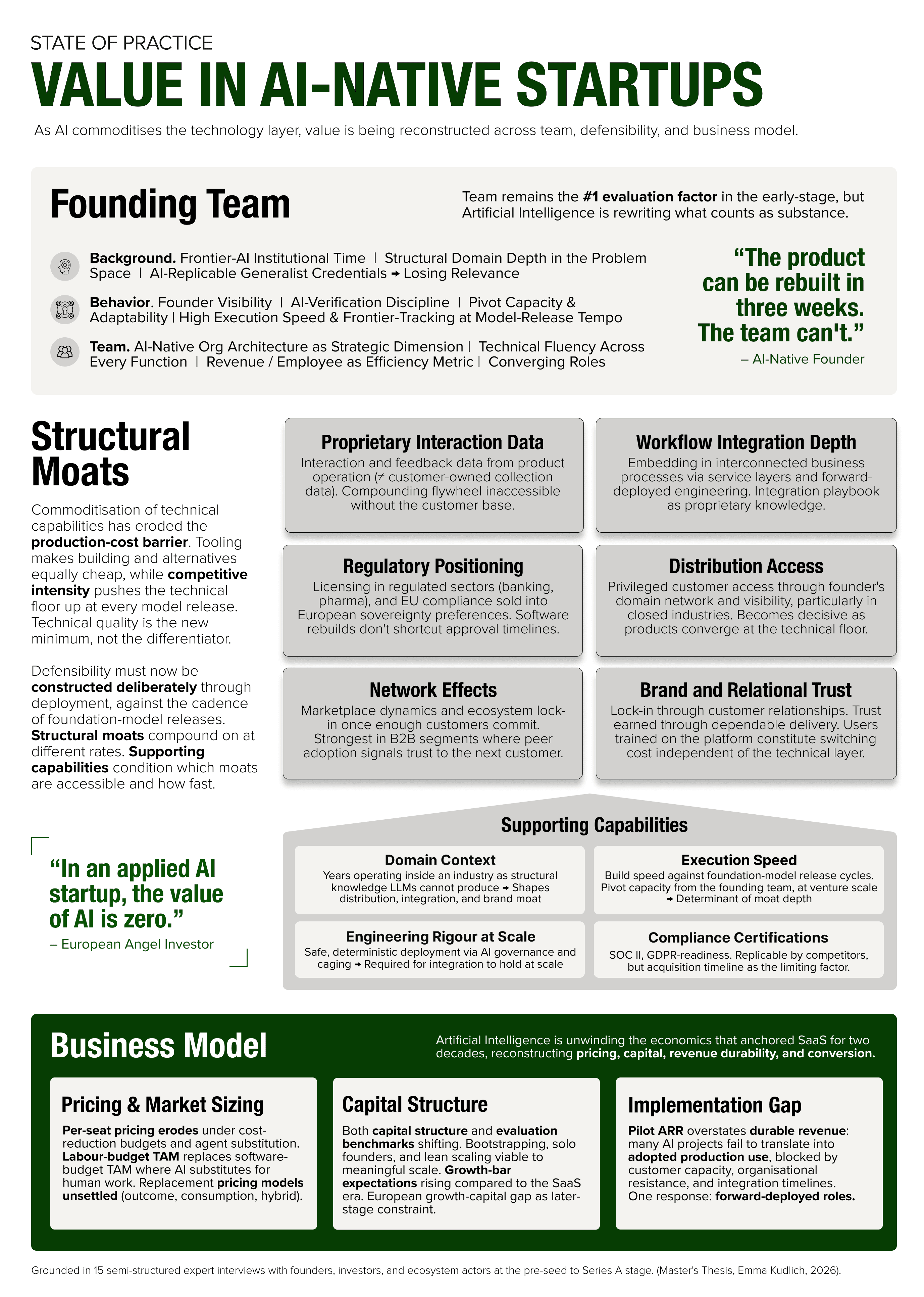
This essay draws on research I conducted for my master’s thesis at ESCP Business School, which examined how founders and investors construct and evaluate value in early-stage AI-native startups. If you are curious about the full research, feel free to reach out.